
Port Huron Resident Lookup Sources
To look up a resident in Port Huron, separate a current address question from a court, family-history, or official-copy question. St. Clair County's property search is a useful parcel cross-check. MiCOURT is a public case-search entry point. The Clerk and MDHHS maintain different vital-record routes, while Michigan election tools have purpose-specific access. None is a master resident list, and each should be read within its stated coverage and limits.
| Record | What It Confirms | Where to Search | Access |
|---|---|---|---|
| County property search | A parcel and a recorded owner-name search path | St. Clair County | Public search form; confirm with Equalization |
| Personal voter information | A person's own registration and polling details | MVIC | Secure individual lookup, not a browse directory |
| Public case search | Case number, court, party role, and public status | MiCOURT | Informational index; exclusions apply |
| Death and marriage leads | Event research and a route to a custodian copy | County Clerk genealogy | Current local index access is limited; call ahead |
| State death index | A statewide death-record lead | Michigan GENDIS | Index lead only, not a certified record |
Start from a full name and a time frame when the goal is a one-person resident lookup. If an address is already known, keep the parcel number separate from the mailing address. If a case is the question, start in MiCOURT with the name and narrow by court or year. For an older family question, the Michigan Room's directories, newspapers, and obituary materials may establish a date before a request is made.
Checking Port Huron Names in MiCOURT
MiCOURT Case Search is the first public screen for a Port Huron court question, but a same-name hit is not proof of identity. The official search guide requires Last Name or Business for a name search. First name, middle name, and birth year refine it. Case-number search instead uses year, number, and type. Compare the court, case number, date, and party role before requesting any underlying document.
| Search field | How it narrows a public query |
|---|---|
| Last Name or Business | Required starting field in the official name-search guide. |
| First Name / Middle Name | Distinguishes people with a shared surname. |
| Birth Year | Additional refinement where the interface permits it. |
| Year / Number / Type | The documented components of a case-number search. |
| Case type, status, public status, dates | Additional filters documented in the MiCOURT API reference. |
Some categories are excluded from public display, including juvenile and other sensitive matters. An empty search is therefore a coverage result, not proof that no record exists.
MiCOURT's documented filters show the available qualifier, status, date, sorting, and pagination options.
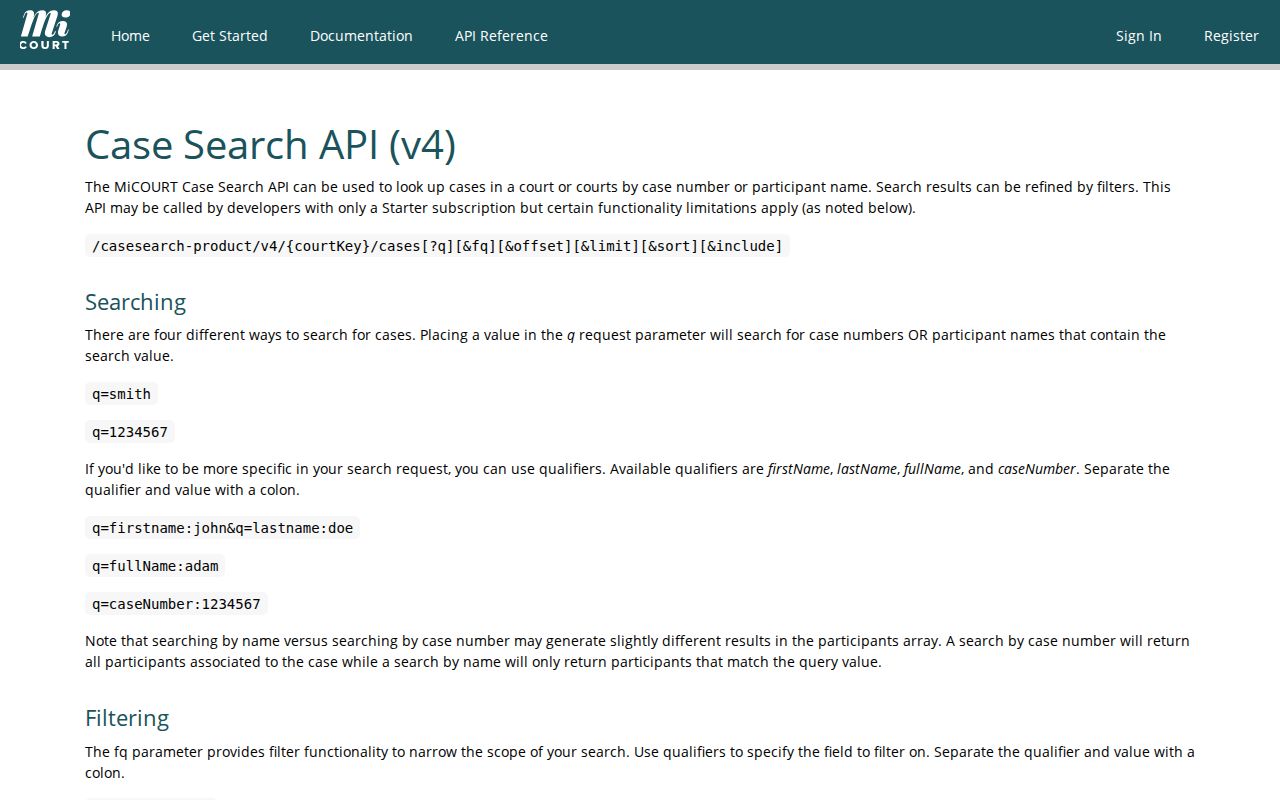
The filter view is useful for recording exactly how a result was limited, especially when several people share a name.
Port Huron Court Copy Requests
A resident lookup can identify a case but cannot replace the court file. St. Clair County has 31st Circuit, 72nd District, and Probate divisions with distinct subject areas. The county's online Circuit document request form is limited to retained 31st Circuit records, so a probate or district request must go to that division instead. The form asks for a document description, two party names, year opened, and, when known, case number and judge.
The form lists a $15 emailed-PDF option, a $5 online processing fee, and added certification charges under its stated terms. Verify the current quote with the Clerk before payment. Michigan court standards list certified copies at $1 per page plus a $10 certification fee, but the clerk is the source for a current order.
The county request form illustrates the information needed for a focused request.
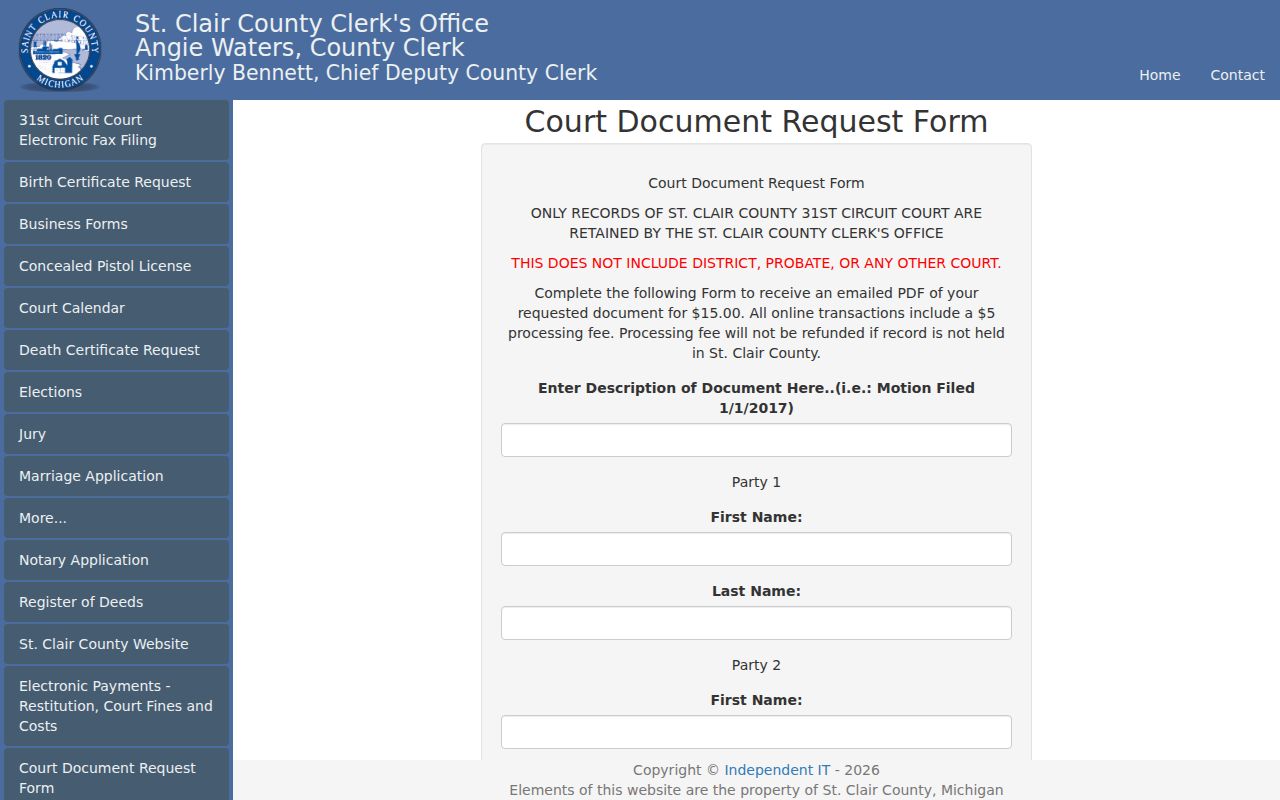
Saving the court division, case number, document description, and year before submitting prevents a general-name search from becoming an unfocused request.
Verifying a Port Huron Resident
Verification works best when each record adds a different fact. A property search can associate a name with a parcel. A public court result can supply a court and case number. A death or marriage index can supply an event lead. Keep a note of the spelling entered, the source, the search date, and the coverage limit. A name alone, a mailing address, or a single index result is not enough to conclude two records belong to the same person.
- Search the county property form by owner name or by an address already known, using one search criterion at a time.
- Record the parcel number and exact name spelling, then use a court search only for the separate court question.
- Compare case year, court, and party role; use a death or marriage index only as an independent event lead.
- Ask the relevant Clerk, court, or MDHHS route for a copy or verification when an official document is necessary.
- Docket
- A court's chronological list of activity in a case, rather than the complete file.
- Index and image
- An index points to a record; an image is a view of the filed or recorded document, which may have a separate access path.
- Certified copy
- A custodian-issued copy bearing the certification required when an official copy is needed.
Port Huron Vital Record Paths
The St. Clair County Clerk genealogy page reports local births from 1867, deaths from 1868, and marriages from 1839. Its current notice matters: genealogy-room access is appointment-only, and ongoing MDHHS updates have limited public index access to death and marriage. Birth indexes and records are not public through that route and have a relationship and death-proof requirement. Call the Clerk before traveling.
MDHHS is the statewide option. Its order page covers records on file since 1867 for core series, with separate eligibility rules for birth records under 100 years. Death, marriage, and divorce requests have a different access path from restricted birth copies. A GENDIS result is a lead, while an MDHHS or county copy is the custodian product.
The county genealogy notice identifies the local date ranges and current access limits.
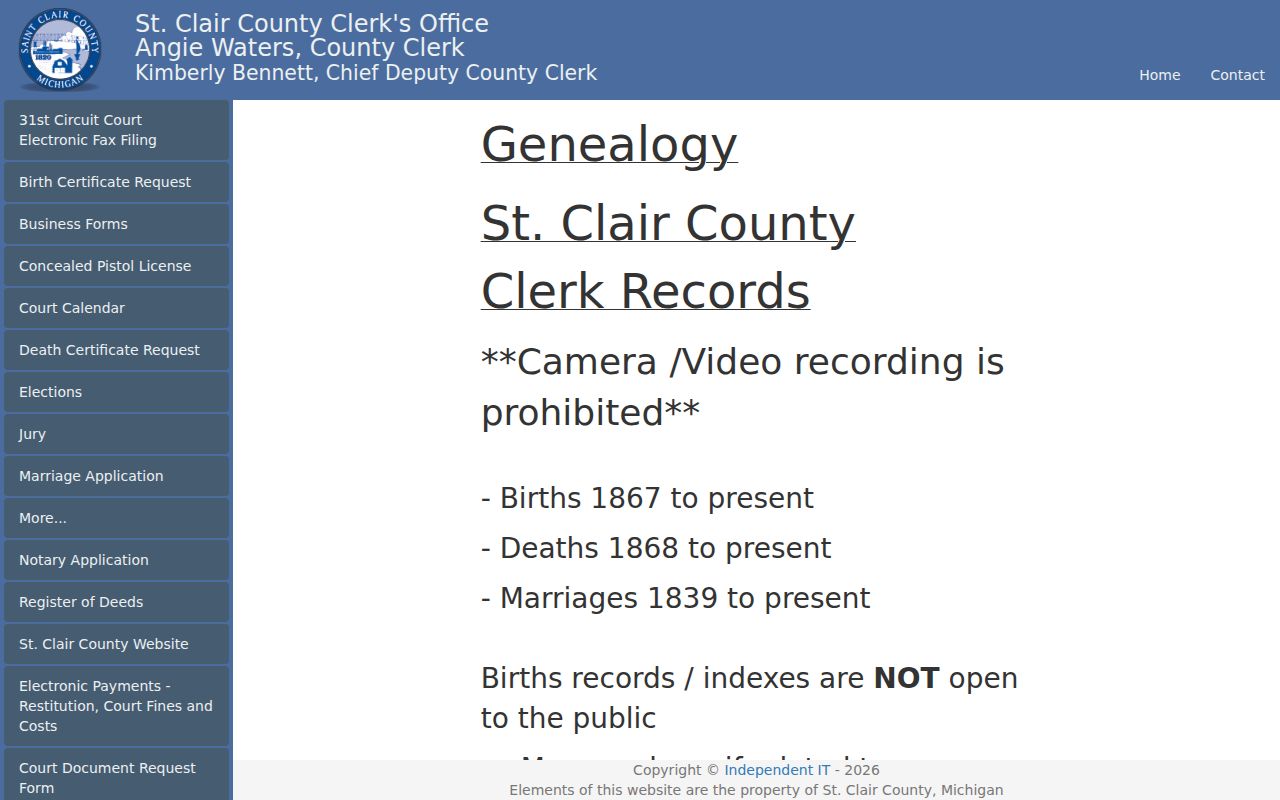
That notice is a reminder to separate an index lead from a certified copy and to check current appointment rules before a visit.
Port Huron Family Research Appointments
For an older Port Huron name, the St. Clair County Library Michigan Room can connect directories, obituary clippings, cemetery indexes, newspapers, maps, and local histories that are not part of a current official index. A visit is most productive when the researcher calls ahead, provides the name, street, and date range, and asks whether non-circulating material can be identified before arrival. That makes a limited research session more precise without treating a library finding aid as a certified record.
The Michigan Room's local-history page gives its current collection and contact information. For an official vital copy, return to the Clerk or MDHHS route after the historical source supplies a documented lead.
Port Huron Records Requests by Scope
When an existing city or county record is not online, Michigan FOIA is a narrow request path, not a request for a new investigation. MCL 15.235 calls for a written request to the public body's FOIA coordinator. Name the office, describe the record, give a date range, and request the segregable nonexempt portion. The normal response period is five business days, with one extension of up to ten business days.
Port Huron's form separates City Clerk and Police contacts and offers email, pickup, fax, or mail delivery. FOIA does not override a restricted birth record, sealed court material, voter-file exemption, or protected address.
Protected Port Huron Resident Information
Michigan public voter information has explicit limits. Driver-license or state-ID data, month and day of birth, phone, email, and other protected application details are not the same as public fields. MVIC is built for a person's own registration details. Broader Qualified Voter File requests require a purpose-specific form, delivery choice, and one selected geography.
The Michigan Address Confidentiality Program provides a substitute address to qualifying participants. It is not a reason to probe for an address, and a missing result may reflect protection, exclusion, or lack of indexing. Send corrections and access questions to the responsible custodian.
Name variants need similar care. Initials, a middle name, a changed surname, or a business-style name can produce related-looking results in a court index or historic directory without identifying the same person. Preserve each source's spelling rather than silently normalizing it. A match becomes stronger only when independent, lawfully available details such as the court, case year, party role, record date, or parcel context agree.
Limits on a Port Huron Resident Lookup
Public availability does not make every field reusable. Court screens can omit sensitive categories, vital records have separate eligibility rules, and an absent result can be sealed, protected, or outside a source's coverage. Use a Port Huron resident lookup for a defined, lawful records question and let the agency correct or certify its own material.
Keep an absence log when a search produces no result: name the agency, exact query, access date, record type, and stated coverage. A missing MiCOURT result may fall within an excluded category; an unavailable vital record can be restricted; and a parcel miss can reflect a street-format change. This record of what was searched is more reliable than treating one empty screen as a conclusion about a person.
Lawful use. Use a Port Huron resident lookup for personal, lawful research, family history, or a specific records question. Never use a result to stalk, harass, intimidate, or harm another person.